
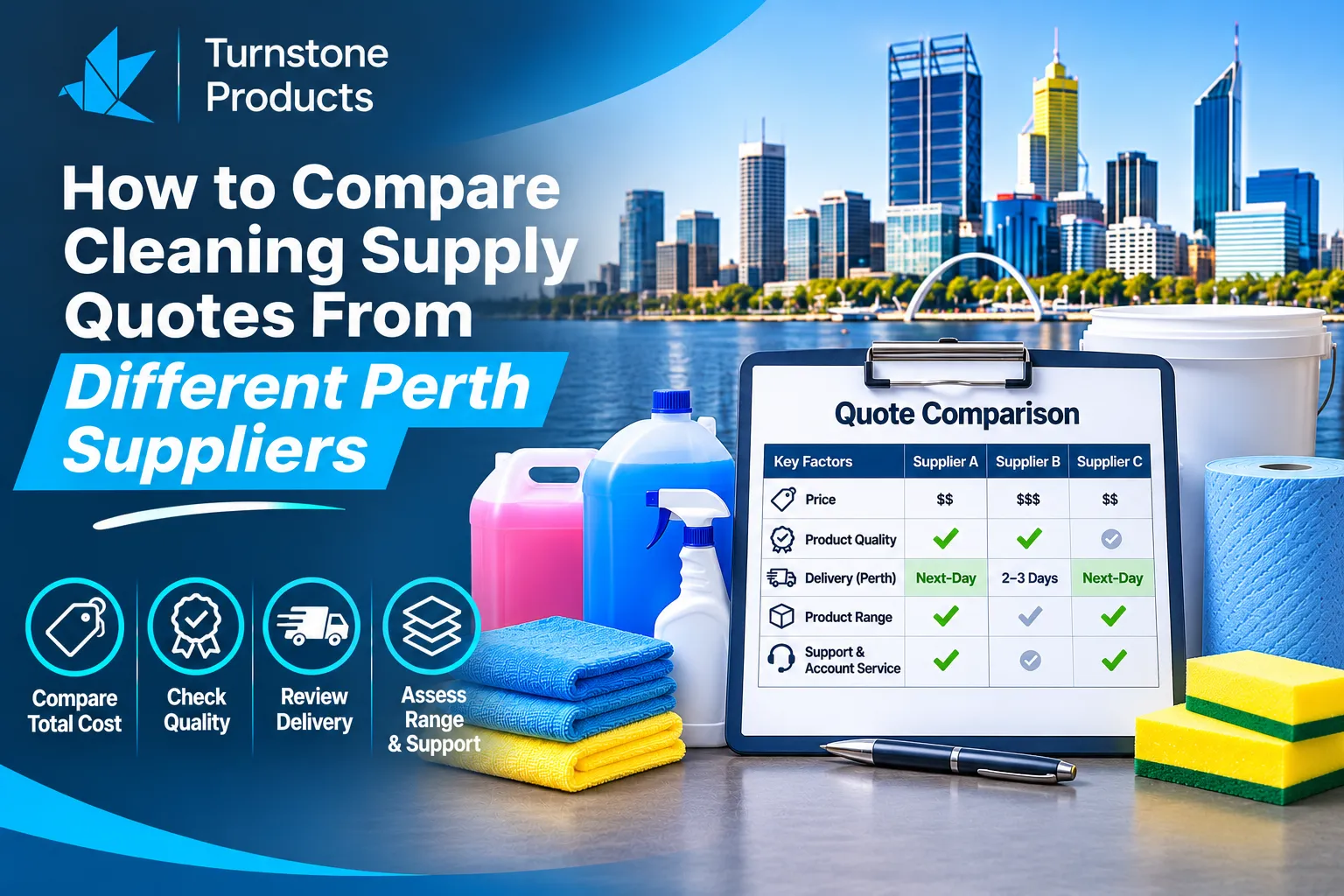
Quick answer: To compare cleaning supply quotes fairly, send every supplier the same list of products, sizes and quantities, ask for itemised pricing, convert each line to a cost per unit (per sheet, per bag, per litre of diluted solution), then add delivery fees and minimum order rules. Finally, weigh price against product quality, stock reliability and delivery speed before you decide.
Getting three quotes for cleaning supplies sounds simple until they land in your inbox. One supplier quotes by the carton, another by the pack. One includes delivery, another adds freight at the bottom. One lists a “premium” hand towel without saying how many sheets are in the box. Before long, you are comparing apples with oranges and picking whichever total looks smallest.
For Perth offices, childcare centres, restaurants, warehouses and healthcare sites, cleaning products are an ongoing cost, so getting the comparison right pays off every month. When weighing up cleaning suppliers perth businesses have to choose from, a little preparation makes the decision far clearer.
Here is a straightforward process you can follow.
Step 1: Write One Product List and Send It to Everyone
The most common reason quotes are hard to compare is that each supplier was asked something slightly different. Fix that by preparing a single request and sending it, word for word, to every supplier.
Your list should cover:
-
Product details. The chemical type, bin liner size and thickness, hand towel fold and size, toilet roll ply, glove material and size.
-
Quantities. How many cartons or packs you expect to order each month.
-
Delivery address. Including any loading dock or access restrictions.
-
Order frequency. Weekly, fortnightly or monthly deliveries.
-
Special needs. Dispenser models your refills must fit, any hygiene standards your site follows, and whether you need Safety Data Sheets supplied.
Ask for an itemised quote, not a single total. Anyone sourcing cleaning supplies perth wa will find that a line-by-line breakdown is the only way to see where suppliers genuinely differ.
Step 2: Convert Every Line to a Cost Per Unit
Once the quotes arrive, ignore the carton prices for a moment. What matters is how much each usable sheet, bag, glove or litre actually costs.
Paper products show this clearly. Here is a hypothetical comparison:
|
Details |
Supplier A |
Supplier B |
|
Carton price |
$42 |
$48 |
|
Sheets per carton |
2,000 |
2,400 |
|
Cost per 100 sheets |
$2.10 |
$2.00 |
These prices are hypothetical and used for illustration only.
Supplier B looks dearer on the invoice but works out cheaper per sheet. Across a year of washroom use, that small gap adds up.
Do the same for every product:
-
Toilet paper: cost per roll, checking ply and sheet count.
-
Bin liners: cost per bag, at the same size and grade.
-
Gloves: cost per glove, in the same material and thickness.
-
Chemicals: cost per litre of diluted, ready-to-use solution.
Concentrates deserve extra care. A five-litre concentrate that dilutes at 1:100 can cost far less per use than a cheaper product that dilutes at 1:20, even if the bottle price is higher. Always base your sums on the manufacturer’s recommended dilution rate.
A simple spreadsheet with one row per product and one column per supplier makes this quick. Once the formulas are set up, you can reuse it every time you review suppliers.
Step 3: Check the Products Are Truly Comparable
A low price only counts if the product does the job. A thin bin liner that splits gets double-bagged, which doubles the cost. A weak cleaner means a second wipe-down and more labour.
Before accepting any line item, check:
-
Does the product suit the task and the surface?
-
Will the refills fit your existing dispensers?
-
Does the packaging suit your storage space?
-
Are Safety Data Sheets available for every chemical?
-
Will the same product be supplied every time you reorder?
If you are unsure about a substitute product, ask for a sample. Testing a carton of hand towels or a bottle of degreaser for a week is a small step that can prevent a costly switch.
Step 4: Add Delivery Costs and Order Rules
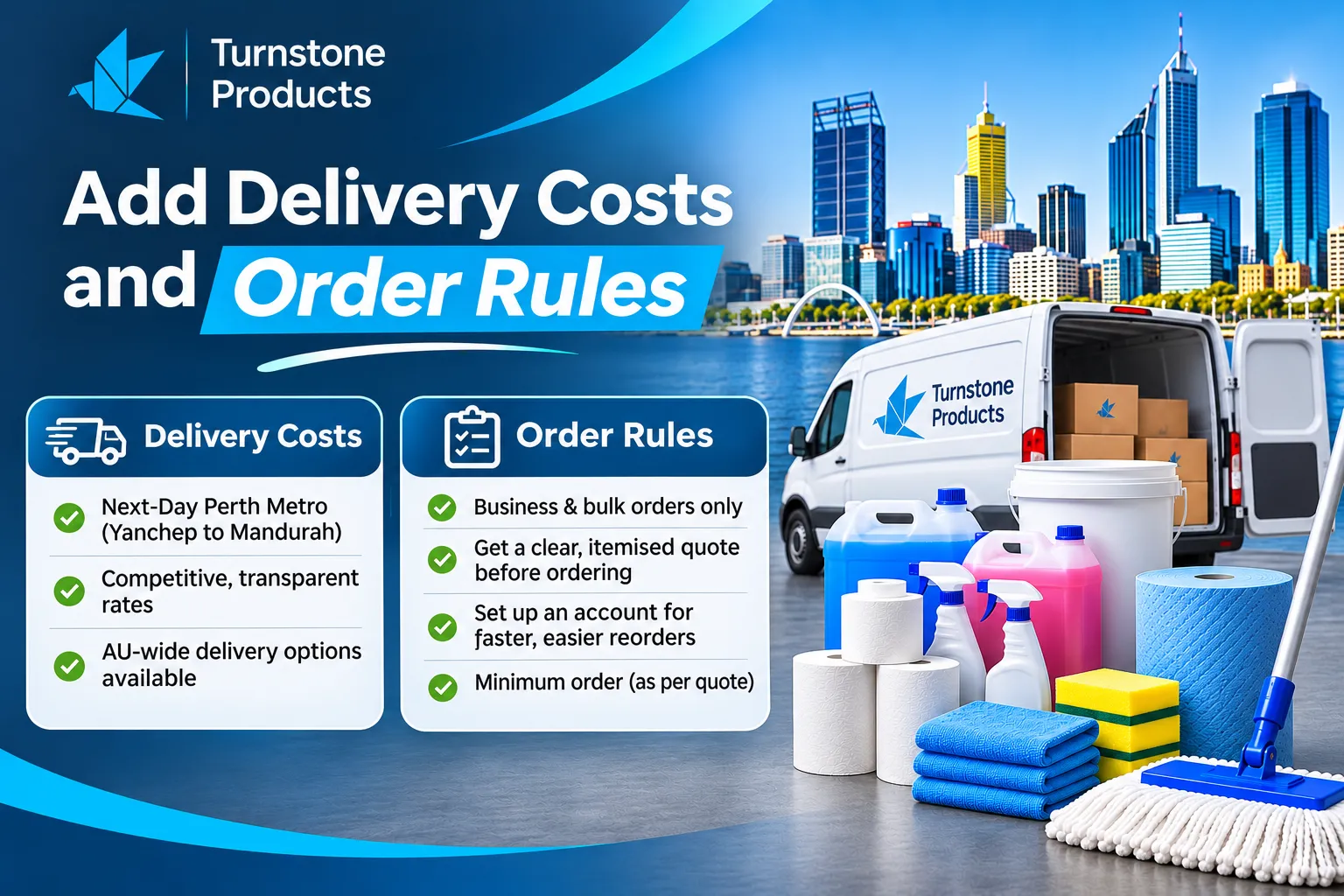
The product price is only part of the bill. Delivery terms can quickly change which quote is cheapest.
Ask each supplier:
-
Is delivery included in the quoted price?
-
Is there a minimum order value or quantity?
-
How long does delivery usually take to your suburb?
-
What is the order cut-off time?
-
Can urgent orders be arranged?
-
Can all products arrive in one delivery?
-
What happens if an item is out of stock?
Add any freight charges to your spreadsheet and spread them across your typical monthly order. A supplier with slightly higher prices but free, next-day delivery can easily beat a cheaper supplier who charges freight and takes a week. For businesses ordering perth cleaning supplies for more than one site, delivery to multiple addresses is also worth asking about.
Step 5: Score Each Supplier on More Than Price
With the numbers sorted, step back and look at the full picture. Many purchasing teams find a simple scorecard helps. Rate each supplier out of five on:
-
Total cost per month, including delivery
-
Product quality and suitability
-
Stock reliability and consistency
-
Delivery speed and flexibility
-
Service, including how quickly they respond and whether they help with product choices
Give extra weight to the factors that matter most to your site. A busy restaurant might rank delivery speed highly, while an office might care most about price and consistency. The supplier with the best overall score is usually a safer choice than the one with the lowest total.
Common Mistakes to Avoid
Even careful buyers trip up on a few things:
-
Comparing carton prices without checking quantities
-
Accepting “equivalent” products without checking specifications
-
Forgetting freight and minimum order fees
-
Choosing a supplier who often runs out of stock
-
Never reviewing quotes again once a supplier is chosen
It is worth repeating the comparison every year or so, or whenever your usage changes significantly.
Why Choose Turnstone Products?
Turnstone Products is a Western Australian, family-owned business supplying commercial cleaning and hygiene products from its base in Neerabup. Its customers include hospitality venues, childcare centres, healthcare providers and commercial cleaners across Perth.
-
Clear, itemised quotes. Send your product list and receive line-by-line pricing that is easy to compare. Bulk orders are arranged by quote rather than online.
-
Next-business-day delivery. Eligible orders across the Perth metro area, from Yanchep to Mandurah, are delivered the next business day.
-
Local stock and its own delivery team. Products are held in Perth, so you are not waiting on interstate freight.
-
One supplier for the essentials. Cleaning chemicals, paper products, bin liners, gloves and dispensers in a single order.
-
Australia-wide supply for bulk orders. Businesses with sites outside Perth can arrange bulk supply as well.
Frequently Asked Questions
How many cleaning supply quotes should a business compare?
Two or three quotes is usually enough. Make sure every supplier quotes against the same product list so the comparison is fair.
What is the best way to compare cleaning product prices?
Work out the cost per usable unit, such as per sheet, per bag or per litre of diluted chemical, then add delivery costs. Carton prices alone can be misleading.
What matters most when choosing a cleaning supplier?
Overall value. Look at total cost, product suitability, stock reliability, delivery speed and service together, not just the lowest price.
Conclusion
Comparing cleaning supply quotes properly takes a little effort up front, but it pays back every month. Send one product list to every supplier, convert prices to cost per unit, check the products match, add delivery terms and score each supplier on overall value. Perth businesses that follow these steps make confident buying decisions and avoid surprise costs down the track.